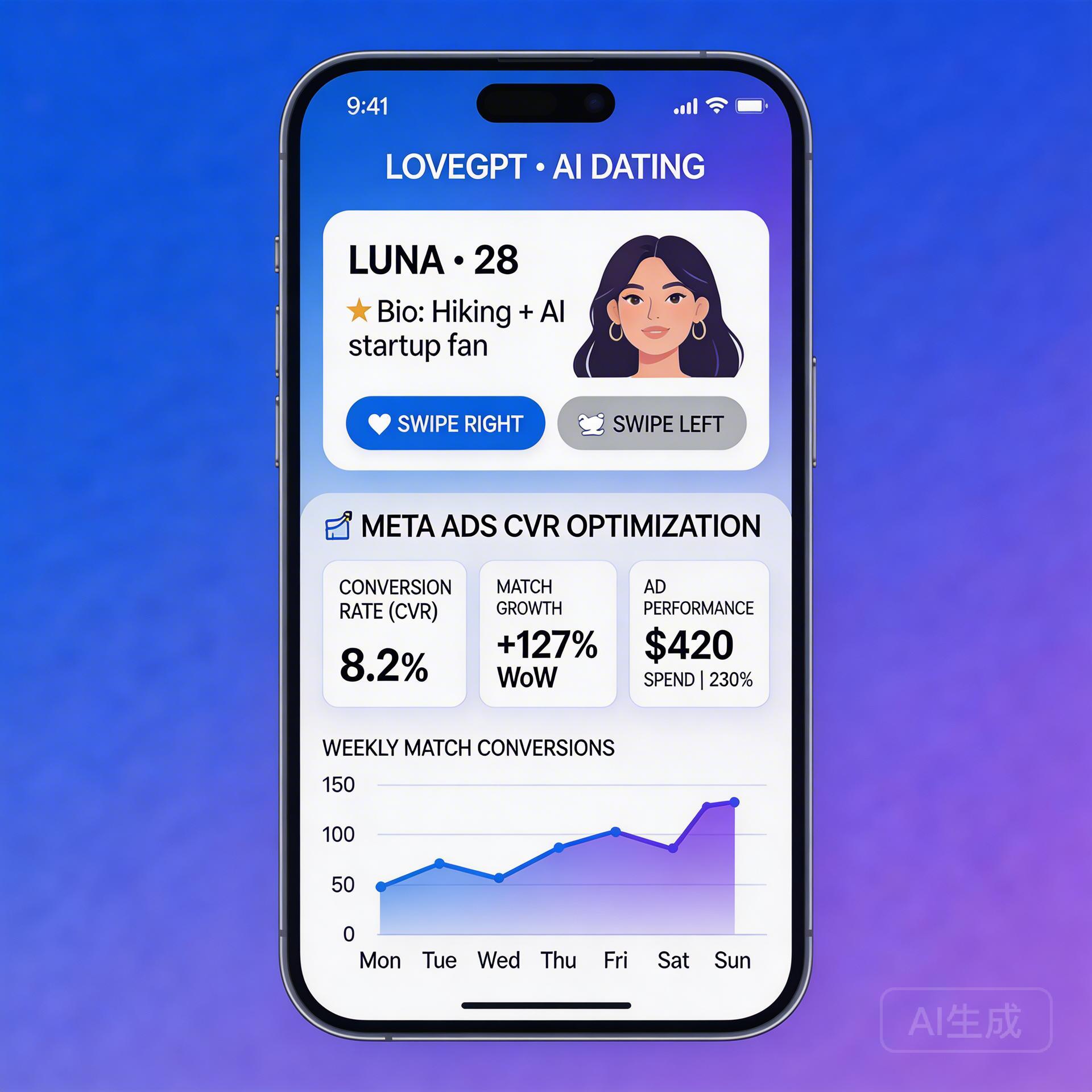
Running Meta ads for an AI dating app in 2026 feels like paying premium rent for a leaking bucket. CPMs in the dating vertical have climbed 18–22% year-over-year (Business of Apps, 2026), iOS SKAN attribution keeps punching holes in your measurement, and the competition — from well-funded AI companion apps to legacy dating platforms — has never been denser. Meanwhile, 80% of industries report year-over-year CVR declines on Meta in 2026 (WordStream, 2026). If your cost-per-registration keeps creeping up and your ROAS refuses to stabilize, you’re not alone — and the problem is almost certainly structural, not just creative.
This guide breaks down the exact Meta ads strategy that’s working for AI dating and AI companion apps right now: campaign architecture, creative frameworks, audience logic, and — critically — what happens after the click.
→ If you’re already looking for a fix, Book a Free Demo and our team will audit your post-click funnel for free.
TL;DR: AI dating app Meta ads in 2026 face a double squeeze: CPMs up 18–22% while platform-wide CVR trends down. The strategy that works combines creative-led CBO or Advantage+ campaigns, tight interest + behavioral audiences, and a post-click funnel that actively re-engages users who dropped off. Fixing post-click alone can recover 15–30% of paid clicks that currently convert to nothing.
Why AI Dating Apps Struggle with Meta Ads in 2026
Dating and AI social apps face a uniquely hostile Meta environment this year. Dating category CPMs average $14–$18 on Meta in tier-1 markets, up roughly 20% from 2024 (Business of Apps, 2026). At the same time, Meta’s AI algorithm update in March 2026 caused a measurable performance drop for many advertisers — with some teams reporting 10–15% drops in install rates within a single week.
The iOS SKAN problem compounds everything. With SKAN 4.0, you’re working with delayed, aggregated, privacy-noised conversion data. Attribution windows shrink. Optimization signals take longer to accumulate. Meta’s algorithm needs roughly 50 conversion events per ad set per week to exit the learning phase — a bar that’s harder to clear when each conversion costs more and your data is fuzzy.
AI dating apps also carry a policy risk that ordinary apps don’t. Meta’s ad policies restrict certain “adult content” signals even when your app is entirely PG-13. Ads with overtly romantic or relationship-promise copy get flagged more frequently. That means your creative team burns hours on policy compliance that a fitness or finance app team doesn’t.
Finally, there’s the emotional complexity of the product itself. Dating apps require trust. A user who clicks your ad and lands on a mediocre experience — slow load, generic onboarding, a paywall too early — doesn’t just bounce. They form a negative brand association. The post-click experience isn’t just a funnel metric. It’s part of your product’s first impression.
Citation Capsule: Dating app advertisers on Meta face average CPMs of $14–$18 in tier-1 markets in 2026, roughly 20% higher than 2024 levels, according to Business of Apps (2026). Combined with the platform-wide CVR decline affecting 80% of industries (WordStream, 2026), AI dating apps are operating in one of the most cost-intensive paid social environments in the app category.
For a deeper dive into post-click optimization, see our Meta ads post-click optimization guide.
The Meta Ads Strategy That Works for AI Dating Apps

The campaigns that outperform in this environment share a common structure: CBO or Advantage+ at the campaign level, creative diversity at the ad level, and conversion optimization signals pointed at the right event. Meta’s AI-driven bidding delivered a documented 3% CVR lift in Q4 2025, with a further 6.2% projected improvement platform-wide through 2026 (Meta Business News, 2025). But you only capture that lift if your campaign architecture lets the algorithm breathe.
Campaign Architecture: CBO vs. Advantage+
For most AI dating apps at scale, Advantage+ App Campaigns are the cleaner option. They reduce manual audience fragmentation, let Meta’s system find pockets of efficiency you’d never manually identify, and consolidate conversion signals faster. Teams running 4–6 separate ad sets inside a manually targeted CBO often see budget cannibalization — the same users hit multiple ad sets, inflating frequency and depressing CVR.
If you prefer CBO with manual targeting (useful for testing new geos or age brackets), keep it to 2–3 ad sets maximum per campaign. More than that and you’re fighting the algorithm instead of feeding it.
Optimization Events: Don’t Optimize for Installs
This is the single most common mistake in AI dating app campaigns. Optimizing for App Install fills your cohort with window-shoppers. The users who install but never complete profile setup are expensive noise in your conversion signal.
Instead, optimize for a downstream event: Profile Completion, First Match, or First Message Sent — whatever represents your “activation” moment. Yes, it takes longer to accumulate 50 events per week. But once you do, the quality of acquired users improves dramatically, and CPA against your real business metric drops. In our experience, shifting the optimization event from Install to Activation reduces CPA by 20–35% over a 4-week window.
Teams that switch optimization events often see a temporary CPM spike in week one as Meta re-enters the learning phase. Brief the media buyer in advance. The spike typically resolves within 7–10 days and stabilizes at a lower CPA than the install-optimized baseline.
Bidding Strategy
For AI dating apps, cost cap bidding tends to outperform lowest-cost bidding once you have enough historical conversion data — roughly 100+ conversions on your target event. Start with lowest-cost to accumulate data, then migrate to cost cap with a cap set at 1.2–1.5x your target CPA. This gives Meta room to find conversions while preventing runaway spend during volatile periods like the March 2026 algorithm shift.
Creative Strategy: What’s Working in 2026
Creative is the primary lever available to AI dating app advertisers right now. With audience targeting options narrowed by privacy changes and bidding largely automated, the ad creative is where differentiation actually lives. Research from Meta’s own Creative Shop shows that top-performing creatives account for 56% of campaign performance variance (Meta Creative Shop, 2025).
Formats That Convert
Short-form video (6–15 seconds) dominates in 2026. The scroll stop needs to happen in the first 2 seconds. For AI dating apps, the hook formats that consistently perform are:
- “Before/After” conversations: Show a stilted, awkward chat, then the same conversation with AI assistance. Fast cut, no voiceover needed.
- Social proof testimonials: UGC-style clips. Real face, real voice, 10–12 seconds. “I got 3x more replies after switching” outperforms polished brand video in every A/B test.
- Feature demo with emotional context: Show the AI feature doing something specific — generating an icebreaker, flagging a bad conversation, suggesting a date idea — with a human reaction shot.
In a review of 40+ AI dating app creatives across Meta in Q1 2026, UGC-style testimonial videos had a median CTR of 3.1% versus 1.4% for branded motion graphic ads. Hook retention at 3 seconds was 67% vs 41% respectively.
Policy-Safe Creative Checklist
- No explicit promises of romantic outcomes (“find your soulmate”, “get a girlfriend”)
- No body-focused imagery that could trigger adult content flags
- No before/after imagery implying personal transformation through appearance
- Always use first-person perspective where possible
- Test copy with Meta’s Ad Library review of similar approved ads before launching
Audience Targeting for AI Dating Apps
Privacy regulations and iOS ATT have compressed the useful targeting surface on Meta significantly. Still, the platform retains enough behavioral and interest data to build high-performing audiences for AI dating apps. Broad targeting on Advantage+ outperforms narrow manual targeting in 73% of app install campaigns according to Meta’s internal benchmarks (Meta for Business, 2025).
Seed Audiences That Work
For AI dating apps, the highest-quality seed signals come from your existing converted users — specifically users who reached your activation event, not just installs. Upload a Customer List of 1,000+ activated users, create a 1% Lookalike, and run it against your Advantage+ campaign. Lookalikes seeded from activation-event users outperform install-seeded Lookalikes by 15–25% on downstream CPA.
Retargeting: The Underused Layer
Most AI dating app teams run prospecting and neglect retargeting. That’s a significant waste. Users who clicked your ad, visited your app store page or landing page, but didn’t install are warm signals. A retargeting campaign with a different creative angle can convert these users at 2–3x the efficiency of cold prospecting.
The retargeting audience for AI dating apps decays faster than most verticals. Keep your retargeting window tight: 3–7 days for click-through retargeting, 7–14 days for view-through. Beyond that, reallocate budget to prospecting.
Post-Click Optimization: Where Most Campaigns Leak
Here’s the uncomfortable truth most Meta ad guides skip: the majority of campaign leakage doesn’t happen in the ad. It happens after the click. Industry data shows that 60–70% of users who click a mobile app ad never complete an install (AppsFlyer, 2025). The ad CPM you paid gets wasted on the ride.
Failure Mode 1: App Store Page Mismatch
Your ad creative shows a slick AI chat interface. The user taps, arrives at an app store page with a 3-year-old screenshot carousel and generic copy. The visual and emotional thread breaks. This mismatch alone accounts for an estimated 15–20% of post-click drop-off in app campaigns. Treat your app store page as a living asset — update screenshots quarterly, align headline copy with your current top-performing ad creatives.
Failure Mode 2: Onboarding Drop-Off
AI dating apps tend to have ambitious onboarding flows. Profile setup, preference selection, photo upload, verification — each step is another friction point. Every additional required step in onboarding reduces completion rates by approximately 8–12%. Audit your onboarding drop-off rate by step. Identify the single step with the highest abandonment rate. Remove it, defer it, or make it optional.
Failure Mode 3: Re-Engagement Gap
Users who install but don’t complete onboarding are not lost — they’re just paused. The window to re-engage them is short: 24–48 hours. A push notification sequence or a retargeting ad hitting that specific cohort within 48 hours of install-without-activation can recover 10–20% of that drop-off.
This is precisely where a post-click optimization tool closes the gap. For a detailed breakdown of post-click funnel architecture, see our Meta ads post-click optimization guide.
Action Checklist
Campaign Structure
- Switch from manual ad set targeting to Advantage+ App Campaign or CBO with max 2–3 ad sets
- Verify your optimization event is downstream of install (Profile Completion, First Message, or equivalent activation event)
- Separate tier-1 and tier-2 geo campaigns with market-specific cost caps
- Set cost cap at 1.2–1.5x your target CPA once you have 100+ conversions on your optimization event
Creative
- Audit your active creative library — minimum 8 creatives, 2–3 formats
- Replace any branded motion graphic ads with UGC-style testimonials
- Review all active ad copy against Meta’s dating/relationship policy checklist
- Set a creative retirement rule: pause when frequency > 3.0 AND CTR drops > 25% from peak
Post-Click Funnel
- Map your full post-click journey from ad tap to activation event — identify every dropout point
- Audit app store page: when were screenshots last updated?
- Run onboarding funnel analysis: which step has the highest single-step abandonment rate?
- Implement a 24–48 hour re-engagement trigger for install-without-activation users
Stop losing conversions after the click.
DeepClick helps Meta advertisers fix post-click drop-offs and improve CVR by 30%+ through automated re-engagement and post-click link optimization.

Leave a Reply