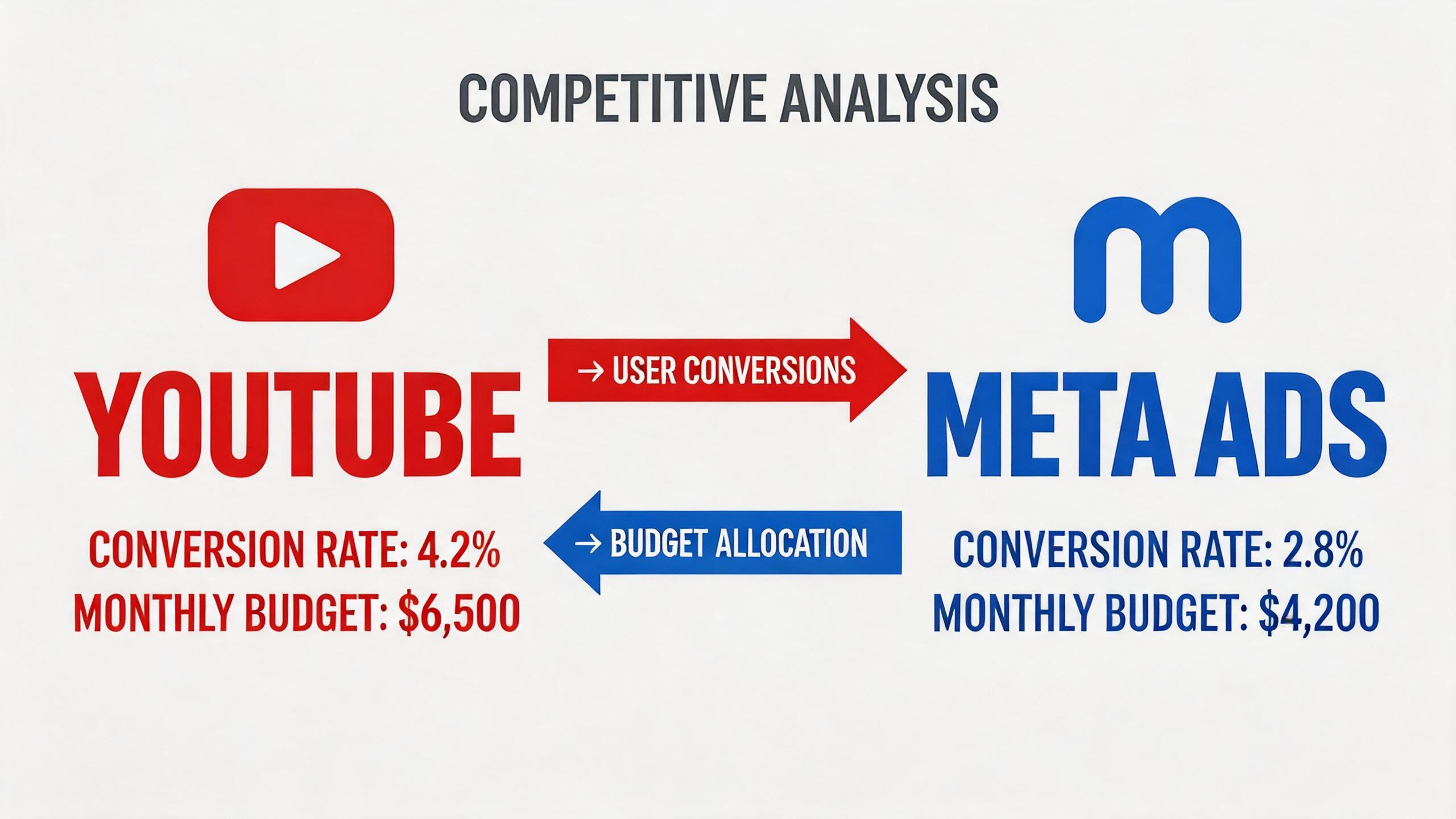
In April 2026, Google dropped a bombshell on the digital advertising world: its latest Demand Gen update positions YouTube as the primary channel for new-customer acquisition. The update emphasizes higher new-customer conversion rates, richer creative formats, and AI-driven audience expansion — all aimed at pulling top-of-funnel budgets away from social platforms like Meta.
For Meta advertisers, this is not just competitive noise. It is a direct signal that the cost of acquiring new customers across platforms is about to shift. If YouTube starts winning more first-touch conversions, Meta’s share of discovery budgets could shrink — and the advertisers who survive will be those with the strongest post-click conversion rates.
This article breaks down what Google’s Demand Gen push actually changes, why it pressures Meta advertisers’ unit economics, and the concrete post-click optimization strategies you can deploy right now to protect your ROAS.
→ Curious how return links work? See DeepClick in 1 minute — no review required, more impressions per click.
Google Demand Gen: What’s Changing
Google’s April 2026 Demand Gen update is not a minor feature release. It represents a strategic repositioning of YouTube within Google’s advertising stack, and it introduces several changes that directly affect the competitive landscape for Meta advertisers.
YouTube as the New-Customer Acquisition Engine
Google is now explicitly marketing YouTube as the top channel for acquiring net-new customers — not just for brand awareness, but for measurable, conversion-tracked acquisition. The Demand Gen campaign type now includes enhanced new-customer value bidding, which lets advertisers assign higher bid values specifically to first-time purchasers. According to Google’s internal data shared at the announcement, advertisers using Demand Gen campaigns saw an average 18% increase in new-customer conversion rates compared to standard Video Action campaigns.
This is significant because YouTube’s reach is massive: over 2.5 billion logged-in users visit YouTube each month, and Google claims that YouTube Shorts now generates over 70 billion daily views globally. By channeling this reach through conversion-optimized campaign formats, Google is building a direct competitor to Meta’s Advantage+ shopping and app install campaigns.
AI-Powered Audience Expansion and Lookalikes
The updated Demand Gen product includes AI-powered audience expansion that functions similarly to Meta’s Advantage+ audience targeting. Google’s system now uses cross-platform signals from Search, YouTube, Gmail, and Discover to build lookalike segments. Early beta results cited by Google show a 25% improvement in cost-per-acquisition (CPA) when using expanded audiences versus manually defined ones.
For Meta advertisers, this means Google is no longer just a search and display competitor — it is now a full-funnel social-style competitor with arguably deeper intent signals.
Richer Creative Formats with Conversion Intent
Demand Gen campaigns now support a wider range of creative placements: YouTube in-feed, YouTube Shorts, Discover, and Gmail — all within a single campaign. Google has also introduced product feeds directly within video ads, allowing viewers to browse and purchase without leaving the YouTube environment. This mirrors what Meta has done with Shops and in-app checkout, but adds the unique advantage of YouTube’s long-form and short-form video context.
Why This Pressures Meta Advertisers’ Conversion Rates

Google’s Demand Gen push creates three distinct pressure points for Meta advertisers. Understanding each one is critical for developing an effective response strategy.
Pressure Point 1: Budget Migration and CPM Volatility
When a major platform launches an aggressive acquisition product, advertiser budgets shift. Industry analysts at eMarketer project that YouTube’s share of US digital video ad spending will reach 8.5% in 2026, up from 7.3% in 2025. That incremental budget has to come from somewhere, and for many advertisers running both Google and Meta campaigns, the natural response is to reallocate Meta top-of-funnel spend toward YouTube Demand Gen tests.
As some advertisers pull budget from Meta, auction dynamics change. Paradoxically, this can cause CPMs to fluctuate in both directions — dropping in some verticals as competition decreases, but rising in others as remaining advertisers bid more aggressively for a smaller pool of high-intent users. The net effect is unpredictable CPM environments, which makes conversion rate the only reliable lever for maintaining stable ROAS.
Pressure Point 2: Higher Conversion Benchmarks Across Platforms
Google’s emphasis on new-customer conversion rates sets a higher bar for what “good” performance looks like. If YouTube Demand Gen consistently delivers 15-20% higher new-customer CVR (as Google claims), CMOs and performance teams will start benchmarking Meta campaigns against those numbers. Meta campaigns that previously looked acceptable at a 2.5% landing page conversion rate will suddenly feel underperforming when YouTube is delivering 3.0-3.5% on comparable audiences.
This benchmarking effect is already happening. A Q1 2026 survey by Varos found that 43% of DTC brands running both platforms reported shifting their primary KPI from platform-level ROAS to blended new-customer CPA — a metric that inherently favors whichever platform converts better post-click.
Pressure Point 3: Attribution Window Compression
Google’s Demand Gen product uses Google’s own attribution stack, including cross-device and cross-platform measurement through Google Ads Data Hub. This gives Google an attribution advantage over Meta, especially in a post-cookie environment where Meta’s 7-day click / 1-day view window is increasingly questioned. Advertisers who see stronger attributed conversions on YouTube may start discounting Meta’s reported numbers, even if Meta’s actual impact is comparable.
The practical implication: Meta advertisers need to fix their cookie and attribution setup to ensure they are capturing every legitimate conversion. And beyond attribution, they need to genuinely improve post-click conversion rates so the numbers hold up under any measurement framework.
Post-Click Optimization Strategies to Stay Competitive
The good news is that post-click conversion rate is entirely within your control. While you cannot control Google’s product roadmap or Meta’s auction dynamics, you can control what happens after someone clicks your ad. Here are four concrete strategies to strengthen your post-click performance in the new competitive landscape.
Strategy 1: Implement Ad Fallback Pages to Recover Lost Clicks
One of the most overlooked inefficiencies in Meta advertising is click waste. When a user clicks your ad but bounces from the landing page — due to slow load times, accidental clicks, or mismatched expectations — that click is gone. You paid for it, but you got nothing back.
Ad fallback pages solve this by creating a secondary engagement opportunity. When a user attempts to leave your landing page, a fallback page presents a simplified offer or alternative action. This is not a generic popup — it is a purpose-built page that matches the original ad context.
The data supports this approach. Advertisers using DeepClick’s return link technology report recovering 10-20% of otherwise lost clicks through ad fallback pages. Because these fallback impressions do not require additional ad review, they effectively give you multiple no-review impressions from a single ad click.
Implementation steps:
- Audit your current bounce rates by campaign and ad set. Identify campaigns with bounce rates above 60% as priority candidates.
- Create fallback page variants that match your top-performing ad creatives. The fallback should offer a simpler conversion action (e.g., email signup instead of purchase, free trial instead of paid plan).
- Set up A/B tests comparing campaigns with and without fallback pages. Measure incremental conversions, not just engagement metrics.
- Monitor ad complaint rates. Well-designed fallback pages should reduce complaints by up to 80%, as users who might have reported the ad out of frustration now have a constructive alternative.
Strategy 2: Align Landing Page Messaging with Advantage+ Automation
Meta’s Advantage+ automation is now the default for most campaign types. This means Meta’s AI is choosing your audience, placements, and often your creative combinations. But here is the problem: Advantage+ optimizes for pre-click performance (CTR, engagement) without any awareness of what happens on your landing page.
This disconnect creates a specific failure mode. Advantage+ may find an audience segment that clicks at high rates but converts poorly because the landing page does not match the creative that Meta’s AI chose to show them. The result is high CTR but low CVR — exactly the wrong combination when you need to compete on conversion efficiency.
Implementation steps:
- Map each Advantage+ creative variant to a corresponding landing page variant. If Advantage+ is showing a product demo video, the landing page should lead with a demo, not a generic homepage.
- Use UTM parameters to track which creative variants drive which landing page visits. Build a creative-to-landing-page performance matrix updated weekly.
- Implement dynamic landing page content that adapts based on the referring ad’s creative ID. This can be as simple as swapping the hero headline and image.
- Set CVR thresholds for each creative-landing page combination. Pause creative variants that drive clicks but not conversions, even if Meta’s system favors them for engagement.
Strategy 3: Fix Attribution Gaps Before They Cost You Budget
In the current environment, every untracked conversion is a vulnerability. If your Meta campaigns are underreporting conversions due to cookie issues, iOS restrictions, or server-side event gaps, your blended CPA looks worse than it actually is — and that makes YouTube’s numbers look even more attractive by comparison.
A comprehensive post-click optimization approach starts with ensuring your conversion tracking is airtight. This is not glamorous work, but it is foundational.
Implementation steps:
- Audit your Meta Conversions API (CAPI) setup. Ensure you are sending all purchase, add-to-cart, and lead events server-side, not just through the browser pixel. According to Meta’s own data, advertisers with properly configured CAPI see 15-25% more attributed conversions.
- Implement event match quality (EMQ) improvements. Your EMQ score should be above 6.0 for key events. Focus on passing hashed email, phone number, and external IDs with every event.
- Set up a weekly attribution reconciliation process. Compare Meta-reported conversions against your backend data to identify gaps. Track the gap percentage over time — it should decrease as you improve CAPI and EMQ.
- Consider implementing a first-party data strategy using server-side cookies with a 180-day expiration. This extends your attribution window beyond what browser cookies allow and helps capture conversions that occur days or weeks after the initial click.
Strategy 4: Build a Cross-Platform Post-Click Measurement Framework
If you are running both Meta and YouTube Demand Gen campaigns (and you probably should be testing both), you need a unified post-click measurement framework that lets you compare apples to apples.
Implementation steps:
- Define a standard set of post-click metrics across platforms: landing page conversion rate, time-to-conversion, new vs. returning customer ratio, and 30-day customer value.
- Implement a platform-agnostic analytics layer (e.g., GA4 with server-side tagging, or a CDP like Segment) that captures post-click behavior regardless of which platform drove the click.
- Run incrementality tests on both platforms. Use geo-based holdout tests to measure true incremental lift from each channel, rather than relying on platform-reported attribution.
- Build a weekly cross-platform report that shows post-click CVR by platform, campaign type, and audience segment. Use this to make budget allocation decisions based on actual conversion performance, not platform-reported ROAS.
Summary and Action Checklist
Google’s Demand Gen push is a structural shift, not a temporary campaign. YouTube is being positioned as a conversion-first acquisition channel, and that changes the competitive dynamics for every Meta advertiser. The advertisers who maintain strong ROAS through this shift will be those who focus relentlessly on post-click conversion optimization.
Here is your action checklist for the next 30 days:
- Week 1: Audit your current post-click conversion rates across all Meta campaigns. Identify the bottom 20% performers and diagnose why they underperform (landing page mismatch, slow load times, attribution gaps).
- Week 1-2: Implement ad fallback pages on your highest-spend campaigns. Target a 10-20% recovery rate on bounced clicks.
- Week 2: Audit your Conversions API and event match quality. Fix any gaps that cause underreporting. Target an EMQ score above 6.0 for purchase and lead events.
- Week 2-3: Align your landing pages with Advantage+ creative variants. Map every active creative to a landing page and ensure messaging consistency.
- Week 3-4: Set up a cross-platform post-click measurement framework. If you are testing YouTube Demand Gen, build a unified dashboard that compares post-click CVR and incremental CPA across platforms.
- Ongoing: Monitor your blended new-customer CPA weekly. The goal is not to beat YouTube on every metric — it is to ensure your Meta campaigns deliver competitive post-click conversion rates under any measurement framework.
The platforms will keep competing for your budget. Your job is to make every click count, regardless of where it comes from. Post-click optimization is no longer optional — it is the competitive moat that separates profitable advertisers from those who get squeezed out.
One ad click, multiple no-review impressions — that’s the DeepClick return link.
DeepClick helps Meta advertisers recover lost clicks with Ad Fallback Pages (+10-20% clicks), reduce ad complaints by 80%, and unlock 5-15% more conversions — without going through ad review again.

Leave a Reply