Meta’s Attribution Model Is Shifting — and Your CPA Targets Need to Follow
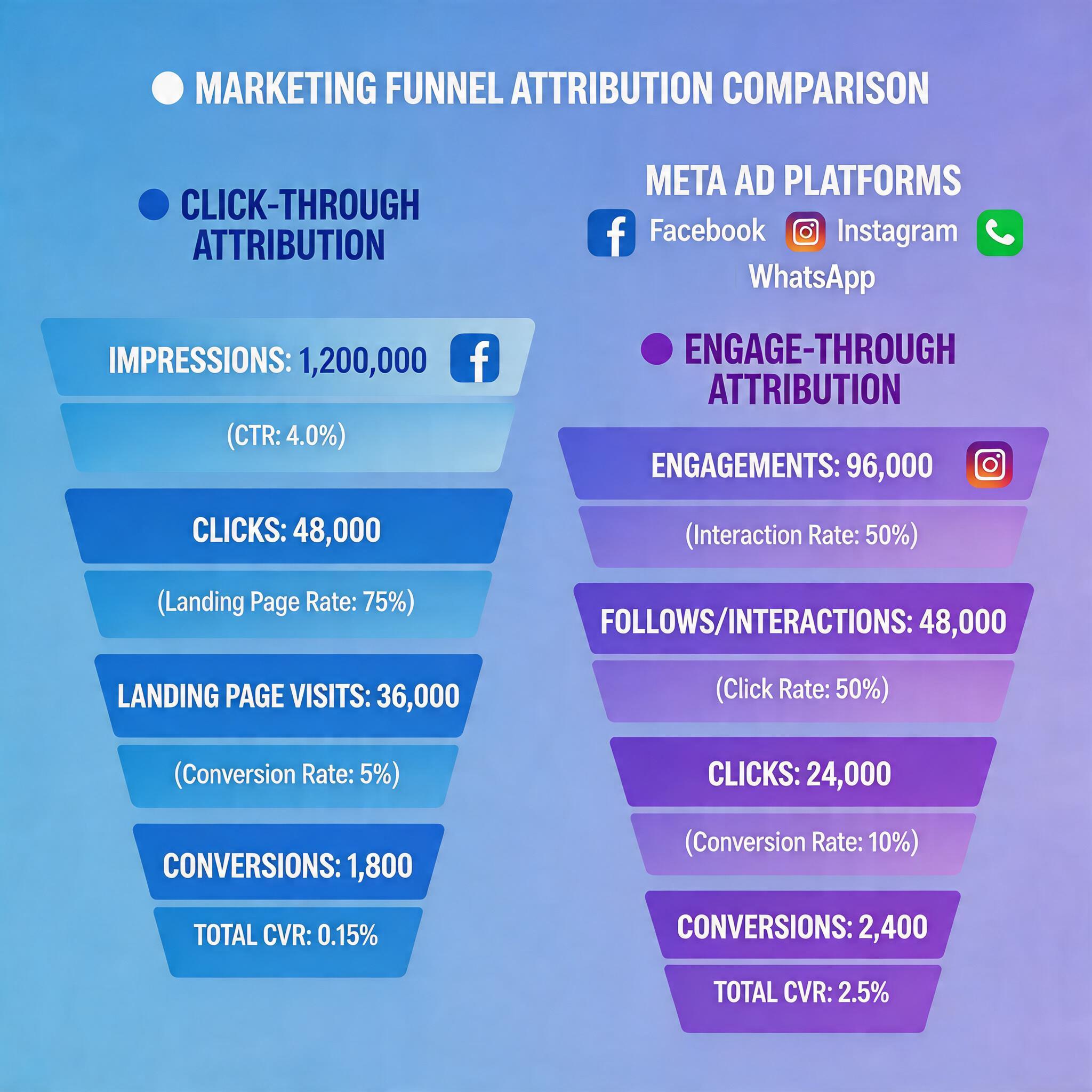
For years, the advertising industry ran on a simple assumption: a user clicks your ad, you get credit for the conversion. Clean. Defensible. Measurable. Meta’s move toward engage-through attribution — where the default credit window expands to include meaningful post-click interactions like video views, carousel swipes, and canvas engagements — breaks that model entirely.
The implications aren’t cosmetic. If you’re still anchoring your CPA targets to click-through conversion data while Meta is grading on an engage-through curve, you’re running blind. Your reported CPA will diverge from Meta’s measured CPA — and the gap will widen as the model rolls out more broadly.
This isn’t a theoretical problem. It’s a reporting discrepancy that burns budgets when performance marketers make decisions based on numbers that no longer reflect reality.
Explore our complete guide to post-click optimization for Meta Ads →
Why Click-Through Attribution Is Becoming a Rearview Mirror Metric

Click-through attribution has one critical flaw: it credits the ad, not the experience after the click. In a world where landing page load time, creative relevance, and post-click journey quality vary wildly across placements, this is a significant blind spot.
Engage-through attribution attempts to close that gap. By recognizing that meaningful engagement with an ad format — a 50% video view, a carousel interaction, an expanded canvas — represents genuine interest signals, Meta is aligning its measurement with how users actually behave across the feed.
For advertisers, this sounds like progress. The catch: your CPA benchmarks are probably wrong if they’re still calibrated against click-through conversions.

The Three-Way CPA Gap: What You’re Now Measuring vs. What Meta Is Counting
Let’s be precise about what changes. Under click-through attribution, a conversion is attributed if a user clicks an ad within a defined window — typically 1 or 7 days — and then converts. Under engage-through attribution, Meta extends credit to users who engage meaningfully with the ad (video view, canvas interaction, carousel engagement) before converting within the same 1-7 day window.
The practical effect: the same conversion event may now be attributed to your ad under engage-through that previously went unattributed under click-through. Your conversion volume appears to increase, which means your CPA — calculated as spend divided by attributed conversions — drops mathematically even if nothing about actual user behavior changed.
This creates three distinct CPA figures you need to track separately:
- Click-through CPA: Your legacy metric, still useful for direct response comparison across platforms
- Engage-through CPA: Meta’s new default — will be lower for most campaigns given expanded attribution credit
- True blended CPA: Actual revenue per conversion divided by all conversions, including those untracked by any attribution model
Running your campaigns against engage-through CPA without understanding its relationship to your click-through baseline is like adjusting a recipe without knowing what ingredient you replaced.
Why Platform Diversification Doesn’t Solve the Problem
Some advertisers respond to attribution complexity by spreading budgets across more platforms, reasoning that a diversified portfolio smooths out measurement discrepancies. This is a defensible risk management strategy for audience reach and creative testing — but it doesn’t fix your CPA calibration problem.
Each platform has its own attribution logic. Google measures to last-click or data-driven. TikTok has its own engagement signals. Mixing platforms without normalizing for attribution methodology creates incomparability across your channels — which defeats the purpose of having a unified performance benchmark.
For AI social apps and game BC advertisers running on Meta, the smarter move is to recalibrate your Meta CPA targets internally — document the delta between click-through and engage-through for each campaign type — rather than spreading budget thin chasing diversification as a measurement fix.
See how leading performance teams are structuring their post-click optimization strategies for 2026 →
Post-Click Optimization: The Variable You Can Actually Control
Here’s what doesn’t change regardless of attribution model: the quality of your post-click experience. Whether Meta credits a conversion on a 1-day click window or a 7-day engage-through window, a user who lands on a poorly optimized page still converts at a lower rate.
The delta between click-through and engage-through CPA isn’t just a reporting artifact — it reflects real users who engaged with your ad but didn’t immediately convert. Those are the users your post-click landing experience has a second chance with.
Post-click optimization levers that matter more under engage-through attribution:
- Page load performance: Every 100ms of delay costs conversion rate. This is well-documented and consistently underinvested.
- Relevance matching: Users who engage with a video ad for 15 seconds and land on a generic landing page convert at significantly lower rates than those who see a matched experience.
- CTA clarity and friction reduction: Under any attribution window, the fewer steps between intent and action, the better.
- Retargeting sequence timing: Engage-through attribution extends your window — which means your retargeting follow-up sequences have more time to convert users who showed interest but didn’t act immediately.
The advertisers who will win under the new attribution model aren’t those with the biggest budgets — they’re the ones who close the loop between ad engagement and post-click experience most effectively.
How to Recalibrate Your CPA Targets Without Losing Your Baseline
Don’t throw away your historical CPA data. You need it as a reference point. Here’s a practical framework for recalibrating targets under engage-through attribution:
Step 1: Establish your baseline ratio. Pull your last 90 days of click-through CPA and calculate your campaign-level engage-through CPA for the same period. The ratio between them is your conversion inflation factor — typically 10-30% depending on campaign type, vertical, and creative format.
Step 2: Apply the ratio to future targets, not past performance. If your click-through CPA was $42 and your engage-through ratio is 1.18x, your new implied CPA target is $35.59. That’s not a new lower target — it’s the same business outcome measured differently.
Step 3: Set separate guardrails for each metric. Continue tracking click-through CPA for cross-platform comparison. Use engage-through CPA as your Meta-specific optimization target. And maintain a true blended CPA based on actual revenue data to validate that your unit economics hold.
Step 4: Re-examine creative performance through a new lens. Formats that drove high engagement but low click-through — think carousel ads,短视频 creatives — may now look dramatically more efficient under engage-through attribution. Let the data redistribute your creative investment.
The Regulatory Variable Nobody Is Talking About
There’s a secondary risk embedded in the attribution shift that deserves attention: digital service tax implications. Several jurisdictions — including the UK, France, Spain, and Italy — have implemented or are implementing digital services taxes that apply to advertising revenues based on where digital interactions occur.
When engage-through attribution captures conversions that click-through missed, you may find yourself with higher reported revenue in jurisdictions with DST exposure — without a corresponding increase in actual business outcome. This is a compliance and tax planning issue that most performance marketing teams haven’t factored into their CPA models.
Before you finalize your post-attribution-shift CPA recalibration, loop in your finance team on the DST implications for your Meta advertising cost structure →
What This Means for Your Q2 and Q3 Budget Planning
The rollout of engage-through attribution won’t be instantaneous across all campaigns and verticals. Meta typically phases these changes — which gives you a window to get ahead of the recalibration rather than scrambling to explain a CPA divergence to stakeholders mid-quarter.
The actions that matter most in the near term:
- Audit your current CPA reporting and identify which campaigns are most exposed to the attribution shift (typically: video-first formats, canvas campaigns, and lead gen campaigns with longer consideration cycles)
- Establish engage-through benchmarks before Meta’s reporting default changes for your account
- Build the post-click optimization layer into your campaign operations — not as a nice-to-have, but as the variable that determines whether your reported CPA improvement is real or just measurement artifact
The advertisers who treat this attribution shift as a post-click optimization problem — rather than a reporting adjustment — will find that the change creates genuine opportunity. When your competitors are arguing about which number is right, you’ll be focused on making the underlying conversion mechanics work harder.
DeepClick helps performance teams close the gap between ad engagement and post-click conversion. If you’re navigating the attribution transition and need a partner who understands the technical and strategic layers, book a free demo →

Leave a Reply