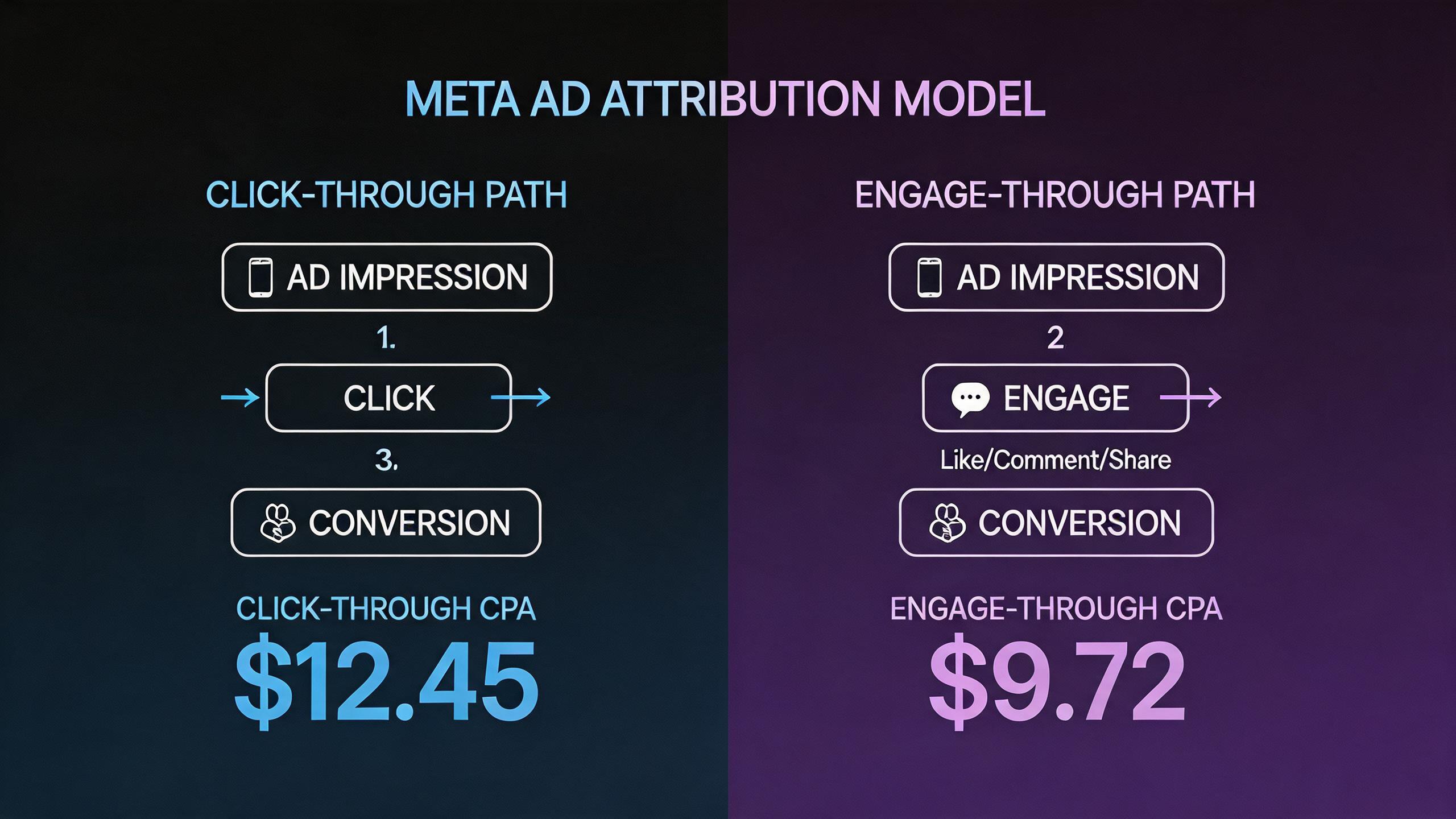
If you’ve noticed your Meta Ads CPA numbers shifting without changing anything in your campaigns, you’re not alone. In early 2026, Meta rolled out a significant attribution model change that separates click-through and engage-through conversion windows — and the ripple effects are hitting every advertiser’s reporting dashboard. The old unified attribution window lumped all post-interaction conversions together, making it nearly impossible to distinguish between a user who clicked your ad and converted versus one who merely engaged (liked, commented, watched a video) and later converted organically. Now that Meta has split these signals, your historical CPA benchmarks may be 15-30% off from reality. This guide breaks down exactly what changed, why it matters for your post-click funnel, and the specific steps you need to take to recalibrate your CPA targets in 2026.
→ Curious how return links work? See DeepClick in 1 minute — no review required, more impressions per click.
What Changed: Meta’s Click-Through vs Engage-Through Attribution Split
Prior to 2026, Meta’s attribution model used a blended window that combined click-through conversions (users who clicked an ad and then converted within the attribution window) with engage-through conversions (users who interacted with an ad — such as liking, commenting, sharing, or watching a certain percentage of a video — and then converted later without clicking the ad itself). Both types were reported under a single “conversion” metric, making it difficult for advertisers to understand the true quality and intent level of each conversion.
Starting in Q1 2026, Meta introduced a clearer separation in its attribution reporting. The two windows now appear as distinct columns in Ads Manager:
- Click-Through Conversions (CTC): Conversions that happen after a user clicks your ad. Default window: 7 days. These represent the highest-intent actions — the user saw your ad, clicked it, visited your landing page, and completed a desired action.
- Engage-Through Conversions (ETC): Conversions that occur after a user engages with your ad (without clicking through) and later converts via another path. Default window: 1 day. These represent lower-intent, brand-awareness-driven conversions.
This change aligns with a broader industry trend. Google’s own attribution models have shifted toward data-driven attribution, and Google PMax campaigns now emphasize post-click landing page conversion signals more heavily. Meta is essentially catching up, giving advertisers the granularity they need to make better budget allocation decisions.
Why This Matters More Than You Think
The split doesn’t just change how numbers appear in your dashboard — it fundamentally alters how Meta’s algorithm optimizes your campaigns. When engage-through conversions were bundled with click-through conversions, Meta’s machine learning treated a “like-then-convert” event with the same weight as a “click-then-convert” event. This inflated conversion counts and deflated CPA, giving advertisers a rosier picture than reality warranted.
Now, with the separation, many advertisers are seeing their reported CPA increase by 15-40% overnight — not because performance actually worsened, but because the engage-through conversions that were padding the numbers are now reported separately. According to early data from agencies managing over $50M in monthly Meta spend, the average CPA increase when looking at click-through only was 22% across e-commerce verticals and 31% across app install campaigns.
Why This Attribution Change Impacts Your Conversion Rates

The downstream effects of this attribution change go far beyond reporting aesthetics. Here’s what the data shows and why your post-click funnel needs immediate attention.
1. CPA Benchmarks Are Now Unreliable
If your Q4 2025 CPA target was $15 and you achieved $14.80, congratulations — but that number likely included 20-35% engage-through conversions. Your true click-through CPA was probably closer to $18-20. Any 2026 campaign planning based on 2025 benchmarks without this adjustment will lead to under-budgeting and missed targets.
A case study from a mid-size DTC brand running Meta campaigns for skincare products illustrates this clearly. Their blended CPA in December 2025 was $12.40. After the attribution split in February 2026, their click-through CPA jumped to $16.80, while their engage-through CPA was $4.20. The total conversion volume didn’t change — but the allocation between the two windows revealed that 28% of their reported conversions were engage-through, with significantly lower lifetime value (LTV). Customers acquired through engage-through had a 40% lower 90-day LTV compared to click-through customers.
2. Post-Click Funnel Leakage Becomes Visible
With click-through conversions isolated, you can now see exactly how your landing page and post-click experience perform for high-intent users. This is a massive opportunity. Before the split, a landing page with a 2.5% conversion rate might have looked acceptable. But if 30% of those conversions were actually engage-through (meaning the user never visited your landing page via the ad), your true post-click conversion rate was closer to 1.75%.
This is where the comprehensive Meta Ads post-click optimization guide becomes essential reading. Optimizing the post-click experience is no longer optional — it’s the primary lever for improving click-through CPA.
3. Budget Allocation Between Prospecting and Retargeting Shifts
Engage-through conversions disproportionately come from retargeting campaigns and brand awareness campaigns where users already know your product. With the split, you’ll likely find that your prospecting campaigns (cold audiences) have a much higher CPA than previously reported, while your retargeting campaigns may actually have a lower CPA because those users are clicking at higher rates.
This data asymmetry means you need to reassess how much budget goes to top-of-funnel versus bottom-of-funnel campaigns. Early data from 2026 suggests that advertisers who reallocated 10-15% of budget from prospecting to retargeting after the attribution split saw an overall 8-12% improvement in blended ROAS within 30 days.
4. Creative Strategy Needs Recalibration
Ads that generate high engagement (likes, comments, shares) but low clicks were previously rewarded by the attribution model because they drove engage-through conversions. Now, those conversions are separated. If your creative strategy was optimized for engagement metrics, you may find that your click-through CPA for those creatives is significantly higher than expected.
This doesn’t mean engagement-focused creatives are worthless — engage-through conversions still have value. But you need to price them differently and understand that a viral video ad with 500K views and thousands of likes may drive brand awareness (engage-through) rather than direct response (click-through).
How to Recalibrate Your CPA Targets: A Step-by-Step Framework
Now that we understand the problem, let’s walk through the specific actions you need to take. This framework has been tested across multiple verticals and budget levels.
Solution 1: Audit and Rebaseline Your Historical CPA Data
Step 1: Export your last 6 months of campaign data. In Ads Manager, go to Reports and export performance data from October 2025 through March 2026. Make sure to include the new click-through and engage-through conversion columns (available in the “Customize Columns” section under “Attribution Settings”).
Step 2: Calculate your click-through-only CPA. For each campaign, ad set, and ad, divide your total spend by click-through conversions only. This gives you your true post-click CPA baseline. Compare this to your blended CPA to understand the gap — this is your “attribution inflation factor.”
Step 3: Set new CPA targets by channel. Use your click-through CPA as the primary optimization target for direct response campaigns. For brand awareness campaigns, you can use a blended metric, but weight click-through conversions 3x compared to engage-through conversions in your CPA calculation. A practical formula:
Adjusted CPA = Total Spend / (CTC + (ETC × 0.33))
This formula accounts for the lower intent and lower LTV of engage-through conversions while still giving them partial credit.
Step 4: Update your automated rules and bid caps. If you’re using bid caps or cost caps based on old blended CPA targets, increase them by your attribution inflation factor (typically 15-30%). Otherwise, Meta’s algorithm will under-deliver because it can’t hit the old CPA target with click-through conversions alone.
Solution 2: Optimize Your Post-Click Funnel for Click-Through Conversions
Since click-through conversions now carry more weight in your reporting and optimization, every percentage point of improvement in your post-click conversion rate has an outsized impact on CPA.
Step 1: Implement landing page speed optimization. Click-through users have high intent but short patience. Data from 2026 shows that Meta ad click-through users have an average attention window of 8 seconds on a landing page. If your page takes more than 3 seconds to load, you’re losing 40% of these high-intent visitors before they even see your offer. Compress images, minimize JavaScript, and use a CDN. Target a Largest Contentful Paint (LCP) under 2.5 seconds.
Step 2: Align landing page messaging with ad creative. Message match is critical for click-through conversions. The user clicked because something specific in your ad resonated — your landing page headline needs to immediately reinforce that promise. A/B test your landing page headlines against your top-performing ad headlines. Advertisers who achieve strong message match see 20-35% higher conversion rates on click-through traffic.
Step 3: Add trust signals above the fold. Click-through users from Meta ads are inherently skeptical — they know they clicked an ad. Place social proof (customer count, ratings, testimonials, trust badges) in the first viewport. A study of 200+ DTC landing pages showed that pages with trust signals above the fold converted click-through traffic at 1.8x the rate of pages without them.
Step 4: Implement exit-intent recovery. For click-through users who don’t convert on their first visit, use exit-intent popups with a specific offer (discount, free shipping, content upgrade). This can recover 5-15% of abandoning visitors and directly reduces your click-through CPA. For Meta advertisers specifically, tools like DeepClick’s return link technology can turn a single ad click into multiple no-review impressions, recovering lost clicks without triggering additional ad review.
Solution 3: Restructure Campaign Architecture Around Attribution Windows
Step 1: Create separate campaign sets for click-optimized and engagement-optimized objectives. Don’t try to optimize for both in the same campaign. Create dedicated campaigns where the objective is website conversions (click-through) and separate campaigns where the objective is engagement or video views (engage-through). This gives Meta’s algorithm clearer signals about what you’re optimizing for.
Step 2: Adjust attribution windows per campaign type. For click-optimized campaigns, use the 7-day click-through window and monitor your CPA at the 1-day, 3-day, and 7-day marks. For engagement-optimized campaigns, the 1-day engage-through window is appropriate. In some verticals (high-consideration purchases like SaaS or real estate), consider extending the click-through window to 28 days if available in your account.
Step 3: Build separate lookalike audiences based on conversion type. Create a lookalike audience from your click-through converters and a separate one from your engage-through converters. Test both, but expect the click-through lookalike to perform significantly better for direct response campaigns. Early testing shows that click-through lookalike audiences have 15-25% lower CPA compared to blended conversion lookalikes.
Solution 4: Leverage First-Party Data to Bridge the Attribution Gap
Step 1: Implement server-side conversion tracking. With the attribution split, the importance of accurate conversion data increases exponentially. Browser-side pixel tracking misses 15-25% of conversions due to ad blockers, cookie restrictions, and iOS privacy changes. Server-side tracking via the Conversions API (CAPI) ensures that every click-through conversion is properly attributed.
Step 2: Set up offline conversion uploads. For businesses with offline conversion events (phone calls, in-store visits, delayed purchases), upload these conversions back to Meta with the correct click ID. This enriches your click-through conversion data and gives Meta’s algorithm more signals to optimize against.
Step 3: Create a unified attribution dashboard. Build a dashboard (in Google Sheets, Looker, or your BI tool of choice) that pulls data from Meta Ads, Google Analytics, and your CRM. Map click-through and engage-through conversions to downstream metrics like revenue, LTV, and retention rate. This gives you a holistic view that no single platform can provide.
As recent analysis of Meta’s ad revenue growth shows, Meta’s platform is outperforming Google on CVR in multiple verticals — but only for advertisers who have adapted their attribution models and post-click funnels to the new reality.
Summary and Action Checklist
Meta’s click-through vs engage-through attribution split is not just a reporting change — it’s a fundamental shift in how conversions are counted, optimized, and valued. Advertisers who adapt quickly will gain a significant competitive advantage, while those who ignore it will continue making decisions based on inflated metrics.
Here is your immediate action checklist:
- This week: Export your historical data and calculate your click-through-only CPA baseline. Identify your attribution inflation factor.
- This week: Update all bid caps, cost caps, and automated rules to reflect the new CPA reality. Increase targets by your inflation factor (typically 15-30%).
- Next 2 weeks: Audit your post-click funnel. Check landing page speed (target LCP under 2.5s), message match between ads and landing pages, and trust signal placement.
- Next 2 weeks: Restructure campaigns into click-optimized and engagement-optimized buckets with appropriate attribution windows.
- Next 30 days: Implement server-side conversion tracking (CAPI) if you haven’t already. Set up offline conversion uploads.
- Next 30 days: Build separate lookalike audiences from click-through converters and test them against your existing audiences.
- Ongoing: Create a unified attribution dashboard that tracks click-through CPA, engage-through CPA, and downstream LTV metrics. Review weekly and adjust targets monthly.
The advertisers who treat this attribution change as an opportunity — to clean up their data, optimize their post-click funnels, and make smarter budget allocation decisions — will be the ones who thrive on Meta’s platform in 2026 and beyond.
One ad click, multiple no-review impressions — that’s the DeepClick return link.
DeepClick helps Meta advertisers recover lost clicks with Ad Fallback Pages (+10-20% clicks), reduce ad complaints by 80%, and unlock 5-15% more conversions — without going through ad review again.

Leave a Reply