
Affiliate Network vs Affiliate Program: Where the Money, Risk and Approval Sit
 Ethan Cole Published on September 17, 2026 · in Account Risk
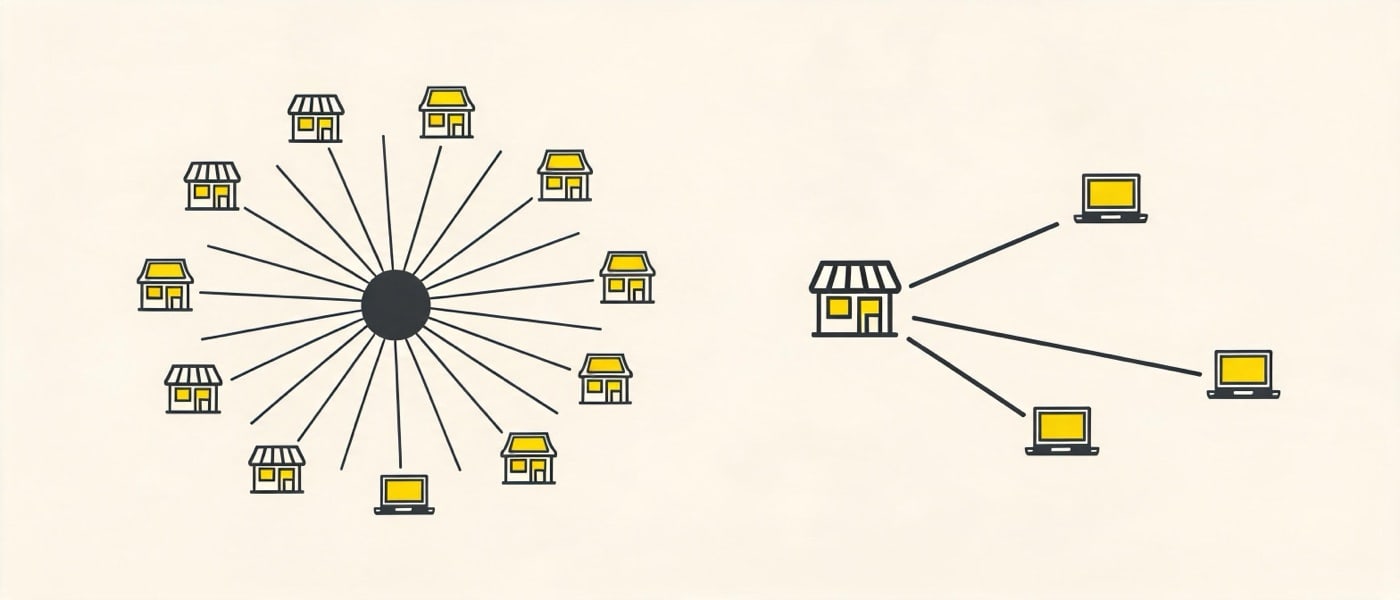
An affiliate network sits between many advertisers and many publishers: you sign up once, it tracks conversions across its catalogue, collects from advertisers and pays you. An affiliate program is one advertiser's own arrangement: you apply to that brand, follow its terms, and the brand pays you. The real difference is who your counterparty is.
That one sentence explains most of what goes right and wrong in affiliate work. This guide compares the two side by side, from the publisher's seat and from the advertiser's, then shows how to tell which one you are actually signing up to. If you want the categories of networks and named examples, see our affiliate networks list.
Affiliate network vs affiliate program: the short definitions
- Affiliate network. A marketplace and intermediary. Advertisers list offers, publishers apply to the network and then to individual offers, and the network runs the tracking, handles reporting and pays out. You deal with one account, one dashboard and one payment relationship for many brands.
- Affiliate program. A single brand's partnership scheme. It may run on the brand's own tracking, on licensed partnership software, or inside a network. "Program" describes the commercial relationship with one brand; it does not tell you who pays you.
That last point is where the confusion starts. Many brands call their scheme an affiliate program even when it is hosted on a network, in which case the network, not the brand, is the party paying you. So the useful question is never "network or program?" in the abstract, but "who holds the money and who do I chase if it does not arrive?"
Side-by-side comparison
|
Dimension |
Affiliate network |
Direct affiliate program |
|---|---|---|
|
Who you contract with |
The network, then each advertiser approves you |
The brand itself |
|
Who pays you |
The network, combined across advertisers |
The brand, separately per program |
|
Signup |
One application, then per-offer approval |
One application per brand |
|
Payment threshold |
Earnings from many advertisers count toward one threshold |
Each brand's threshold is met on its own |
|
Offer discovery |
A searchable catalogue |
You find brands yourself |
|
Tracking and reporting |
One system across all offers |
Whatever the brand chose |
|
Disputes and reversals |
Raised through the network |
Negotiated with the brand directly |
|
Commission terms |
Set by the advertiser, sometimes tiered by the network |
Set by the brand, often more negotiable at volume |
|
Relationship |
Account manager at the network, sometimes at the brand |
Direct contact with the brand's partner team |
No row is a verdict on its own. A network's single threshold matters a lot when you run small volumes across many brands; a direct line to the brand matters more once one brand accounts for most of your conversions.
Where the money and the risk sit
In a network, the network is your counterparty. If an advertiser pays late or disputes a batch of conversions, the network is the one chasing it. Whether you get paid before that advertiser settles depends on the network: some pay on their own schedule, others release commission only after the advertiser has paid them, and the publisher terms say which. You are exposed to the network's own reliability, and you rely on its tracking being the record of truth.
In a direct program, the brand is your counterparty. There is no intermediary to absorb a late payment, and if the brand changes terms, pauses the program or rejects conversions, you negotiate directly. The upside is a shorter chain: fewer parties interpreting the same click, and a partner manager who can actually change something.
Neither setup removes the need for due diligence. Payment reliability is the one thing you cannot read off a signup page, which is why operators compare notes in affiliate marketing forums and media buyer communities before committing traffic.
The same choice from the advertiser's side
Advertisers face the mirror image of this decision: join a network, or run an in-house program on partnership software.
- Joining a network buys access to an existing publisher base, a tracking and payment layer, and compliance tooling. The price is usually a platform fee plus a per-transaction fee on top of the publisher commission. Awin's published US advertiser pricing is a concrete example: its Access plan lists a monthly fee plus a 3.5% tracking fee per transaction, with the worked example that on a 100 USD sale at 6% commission, the partner receives 6 USD and Awin receives 3.50 USD.
- Running an in-house program means licensing partnership software (or building tracking), then recruiting, approving, paying and policing partners yourself. There is no per-transaction network fee, but the work of finding partners and handling disputes moves in-house.
Many brands do both: a network for reach and a direct arrangement for their largest partners. For a publisher, that means the same brand can appear under two sets of terms. Check which link and which terms apply before you send traffic, because conversions tracked under one arrangement are not paid under the other.
How to tell which one you are signing up to
Brand pages rarely say "this program runs on a network." Four checks answer it in a few minutes:
- Read the contracting party in the terms. The publisher agreement names the legal entity you contract with. If it is a network's company name, you are in a network relationship even if the page is branded.
- Look at where the signup form posts to. A redirect to a network or software login domain tells you where your account will live.
- Find who issues payment. The payment section states who pays, in which currency, by which method and on what schedule. That party is your counterparty.
- Check how disputes are handled. Terms that route reversals and appeals through a network's support desk confirm a network relationship; terms that name the brand's partner team indicate a direct program.
Software-hosted programs are the tricky case. A platform that brands use to run their own programs is not your counterparty: you join each program separately, and if a brand stops paying, the software provider is generally not obliged to cover it.
Which to start with
- New publisher, no track record: a network is usually the practical start. One approval process, a catalogue to test against and one payment threshold across small earnings.
- Concentrated volume with one brand: ask that brand whether it runs a direct arrangement. A direct relationship gives you a named contact and room to discuss terms that a catalogue listing does not.
- Paid traffic: whichever route you take, get the allowed traffic sources in writing for each offer. Running an offer on a source its terms exclude is the most common reason conversions go unpaid.
- Many small brands in one niche: stay with networks until a single brand justifies its own relationship.
When you are ready to look beyond catalogues, our guide on how to find affiliate partners covers where direct partners are actually found and how to vet them.
Not the same as an ad network
"Ad network" and "affiliate network" are easy to mix up. An ad network, such as Google AdSense on the publisher side, places display ads on your pages; according to Google's AdSense Help, publishers are paid based on user clicks on ads or on ad impressions, depending on the ad type. An affiliate network pays you only when a defined action happens on the advertiser's side, such as a sale, a lead or an install. The traffic you need, the content you build and the way you are measured are different in each.
Rules that apply either way
- Disclosure. The US FTC's guidance on endorsements says affiliate marketers should disclose their relationship with the retailer clearly and conspicuously, close to the recommendation. That applies whether the commission comes from a network or directly from the brand.
- Offer terms override your assumptions. Traffic source restrictions, brand bidding rules and coupon-site rules are set per offer and are enforced by reversing conversions.
- Invalid traffic is not paid. Automated clicks, incentivized traffic that an offer does not allow and misleading creatives lead to reversals and closed accounts in both models.
FAQ
Is an affiliate network better than an affiliate program?
Neither is better in general. A network is easier to start with and pools small earnings toward one payment; a direct program gives you a direct counterparty and more room to negotiate once you bring real volume to one brand.
Can a brand's affiliate program be run through a network?
Yes, and it is common. The brand sets commission and approves partners, while the network tracks conversions and pays you. The publisher agreement and payment terms tell you which party you actually contract with.
Do publishers pay to join affiliate networks?
Mainstream networks generally make their money from advertiser fees rather than publisher fees, though some ask for a small deposit or verification step at signup. Read the publisher terms before joining, and treat any demand for a large upfront payment as a warning sign.
Can I promote the same brand through a network and directly?
Only under one set of terms at a time for the same traffic. If a brand runs both, confirm which tracking link applies to you, because conversions recorded under one arrangement are not paid under the other.