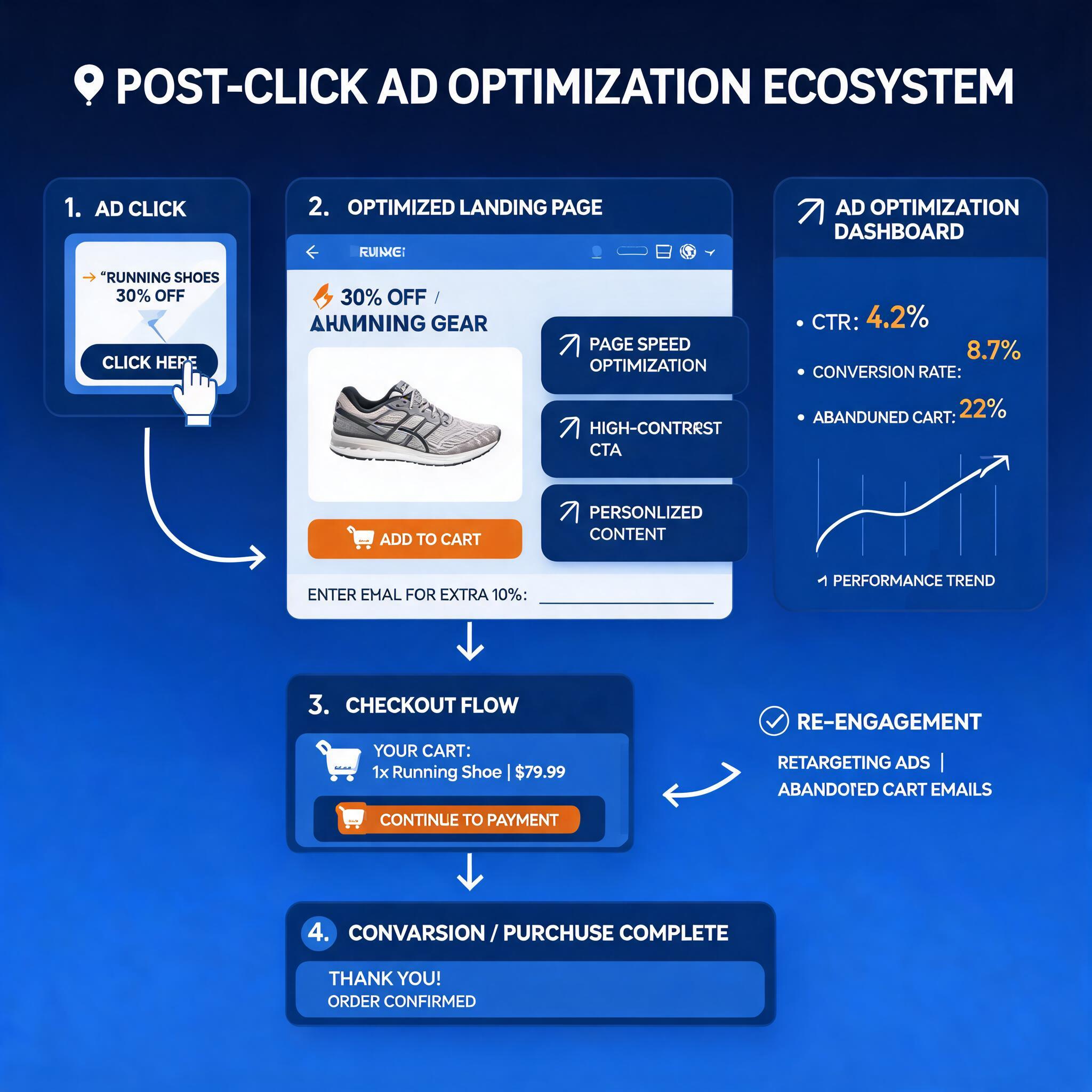
You’ve optimized your Meta ad creative. Your targeting is dialed in. Your budget is healthy. But if your post-click experience isn’t converting those hard-won clicks into customers, you’re burning money at the most expensive point in your funnel. Post-click optimization is where the gap between profitable Meta campaigns and break-even ones lives — and most advertisers barely touch it.
This guide covers everything performance advertisers need to know about Meta ads post-click optimization in 2026: from attribution fundamentals to landing page conversion, from cost control strategies to cross-platform diversification. Each section links to detailed tactical guides so you can go as deep as your campaigns require.
→ Curious how return links work? See DeepClick in 1 minute — no review required, more impressions per click.
What Is Post-Click Optimization and Why It Matters More Than Ever
Post-click optimization is everything that happens between a user clicking your Meta ad and completing (or abandoning) a conversion. It encompasses landing page experience, page load speed, form design, checkout flow, and re-engagement mechanisms for users who don’t convert on their first visit.
In 2026, post-click optimization matters more than ever for three converging reasons. First, Meta’s rising ad costs — driven by both competitive pressure and new digital services taxes — mean every click is more expensive, so each click must work harder. Second, privacy changes (iOS ATT, browser cookie deprecation) have degraded Meta’s targeting precision, sending less-qualified traffic that demands better post-click funnels to convert. Third, Meta’s shift toward broad targeting and automation (Advantage+ campaigns) means you’re getting a wider mix of user intent, making your landing page’s job harder.
The math is straightforward: a 1% improvement in post-click conversion rate typically delivers 2–5x the ROI impact of a 1% improvement in click-through rate. Yet most ad teams spend 90% of their optimization time on pre-click elements (creative, targeting, bidding) and 10% on post-click. Flipping this ratio is the single highest-leverage change most Meta advertisers can make.
Meta Attribution Fundamentals: Understanding What You’re Measuring

Before you can optimize post-click performance, you need to understand how Meta counts conversions — because Meta’s attribution model significantly influences what your data tells you.
Meta now separates attribution into two distinct windows: click-through attribution (user clicked ad, then converted within 7 days) and engage-through attribution (user interacted with ad without clicking, then converted organically). The practical impact is enormous — many advertisers discover that 30–50% of their reported conversions are engage-through, meaning their true direct-response CPA is significantly higher than dashboards show.
Understanding this distinction is the foundation of honest post-click optimization. If you’re optimizing based on total reported conversions (click-through + engage-through combined), you’re including users who may have converted regardless of your ad. True post-click optimization focuses on click-through conversions — the users you actually sent to your landing page.
For a deeper dive into recalibrating your CPA targets based on the attribution split, see our guide on Meta attribution changes and CPA recalibration. And for the tactical breakdown of how click-through vs. engage-through attribution affects your conversion data, read the detailed analysis in click-through vs engage-through post-click impact.
Landing Page Conversion: The Core of Post-Click Performance
Your landing page is where post-click optimization happens in its purest form. A high-converting landing page for Meta traffic needs to accomplish three things within 5 seconds: confirm ad-message match (the user sees what the ad promised), establish trust (social proof, brand credibility), and present a clear next action (single CTA, no navigation distractions).
Speed Is the Foundation
For mobile-first Meta traffic, page load speed is non-negotiable. A landing page that loads in 1–2 seconds converts at 2–3x the rate of one loading in 4–5 seconds. Every second of delay costs you 7–12% of potential conversions. For AI social app campaigns where CPAs already run $5–15 per install, those lost conversions represent thousands of dollars in monthly waste.
Prioritize Largest Contentful Paint (LCP) under 2.5 seconds, First Input Delay (FID) under 100ms, and Cumulative Layout Shift (CLS) under 0.1. Strip unnecessary JavaScript, compress images, and use lazy loading for below-fold content. If your landing page includes video (common for AI dating app promos), use thumbnail previews that load instantly with video loading deferred to user interaction.
Message Match and Visual Continuity
The moment a user clicks your Meta ad and arrives on your landing page, they’re making a split-second judgment: “Is this what I expected?” If there’s a disconnect between ad creative and landing page content — different imagery, different messaging tone, different offer — bounce rates spike 40–60%.
For each ad creative running at scale, build a dedicated landing page variant that mirrors the ad’s visual style, headline, and value proposition. Dynamic text replacement (DTR) can help at scale, but for your top 5 campaigns by spend, custom landing pages always outperform generic ones.
Conversion Path Simplification
Every form field, every extra step, every unnecessary choice you present costs conversions. For mobile game install campaigns, the ideal landing page has zero form fields — it’s a single page with a prominent install/download CTA. For AI app signups, minimize to email-only registration with social login options.
When your Meta ad costs rise due to external factors like the digital services tax surcharges rolling out globally, landing page conversion improvements become even more financially impactful — every percentage point of CVR improvement offsets a larger absolute cost increase.
Cost Control: Managing Rising Meta Ad Costs
Meta advertising costs have been climbing steadily, driven by increased competition, platform monetization pressure, and now government-imposed digital services taxes. For performance advertisers, the question isn’t whether costs will rise — it’s how to maintain profitability despite them.
Post-click optimization is the most effective cost control mechanism because it improves the denominator of your CPA equation without requiring additional spend. If your CPA is $20 and you improve post-click CVR by 25%, your new CPA drops to $16 — equivalent to a 20% reduction in media costs, achieved without negotiating a single discount.
The key insight is that post-click improvements compound over time. A landing page improvement you make today continues to deliver benefits on every future click, whereas a creative optimization eventually fatigues and needs replacement. This makes post-click optimization the only advertising investment that actually appreciates.
For teams managing cross-platform budget allocation, understanding how Google Ads conversion value benchmarks compare to Meta CPA targets helps identify where your marginal dollar creates the most conversion value.
Automation and Advantage+: Optimizing Within Meta’s AI Systems
Meta’s push toward Advantage+ campaigns and automated targeting represents a fundamental shift in how advertisers interact with the platform. Advantage+ Shopping, Advantage+ App, and broad-targeting campaign structures all hand more control to Meta’s algorithms — which means your post-click experience is the primary variable you still control.
When Meta’s algorithm selects your audience and determines your bid, the landing page becomes the only lever for differentiation. Two advertisers targeting the same audience with the same budget will see dramatically different results if one has a 2% post-click CVR and the other has 4%. The algorithm will preferentially serve ads from the higher-converting advertiser because better post-click performance improves platform-wide user experience metrics.
This creates a virtuous cycle: better post-click experience → higher quality score → lower CPM → more impressions → more data for optimization → even better performance. The reverse is also true — poor post-click experience triggers a death spiral of rising costs and declining reach.
For a detailed breakdown of how Advantage+ automation defaults interact with post-click optimization, including specific settings that matter most for conversion-focused campaigns, see our tactical guide.
Cross-Platform Strategy: Beyond Meta
Effective post-click optimization doesn’t operate in a Meta silo. As ad costs rise and attribution becomes more complex, smart advertisers are diversifying their traffic sources — and applying the same post-click optimization principles across all of them.
Google Ads Complementary Strategy
Google Ads (Search, Display, YouTube, and Performance Max) offers fundamentally different user intent signals than Meta. Google users are actively searching for solutions; Meta users are being interrupted with suggestions. This intent difference means your post-click experience should be adapted for each source.
For Meta traffic, emphasize discovery and emotional engagement — these users didn’t ask for your product, so you need to earn their attention quickly. For Google traffic, emphasize specificity and conversion — these users already know what they want.
The interplay between Google’s algorithm changes and Meta’s ad ecosystem creates opportunities for alert advertisers. When Google removed its Display and Video planning tools, it signaled a shift toward conversion-focused advertising that mirrors Meta’s own trajectory — making post-click optimization the common denominator of success across both platforms.
TikTok and Emerging Platforms
TikTok’s 2026 algorithm update prioritizing SEO-style content discovery changes the game for app advertisers. Content that ranks well organically on TikTok drives zero-cost impressions that feed into your paid conversion funnel. When these organic viewers click through to your landing page, they arrive with higher intent than typical social interruption traffic.
The post-click implication: build landing pages that handle mixed-intent traffic. A user arriving from a TikTok organic discovery has different expectations than one arriving from a paid Meta ad. Dynamic landing pages that detect traffic source and adapt messaging accordingly can improve CVR by 15–25% compared to one-size-fits-all pages. Our analysis of TikTok’s algorithm changes and their impact on Meta conversion strategy covers how to adapt your cross-platform approach.
Measurement and Analytics: Tracking What Actually Matters
Post-click optimization requires post-click measurement — and in 2026’s privacy-first environment, that means rethinking your analytics stack.
Essential Post-Click Metrics
- Landing page bounce rate by traffic source: Meta traffic typically bounces at 45–65%. If yours is above 55%, there’s a message match or speed problem.
- Time-to-first-action: How quickly do users engage with your page after arriving? Target under 8 seconds for mobile Meta traffic.
- Micro-conversion rates: Track intermediate actions (scroll depth, video plays, button hovers) to diagnose where users disengage before the primary conversion.
- Return visit conversion rate: What percentage of users who don’t convert on first visit come back and convert later? This measures the effectiveness of your re-engagement mechanisms.
- Revenue per click (RPC): The ultimate post-click metric — total revenue divided by total ad clicks. Improving RPC is the goal that all other post-click optimizations serve.
Attribution Accuracy
Cookie deprecation and browser privacy restrictions mean client-side tracking misses 15–30% of conversions. Implement server-side tracking via Meta’s Conversions API to capture the full picture. For guidance on fixing attribution gaps specifically related to cookie changes, see our deep-dive on Meta ads cookie attribution and conversion fixing.
For teams evaluating how Google’s AI-driven campaign types handle attribution differently, understanding Google AI Max campaigns and DSA audit implications provides useful comparative context.
Re-Engagement: Recovering Lost Conversions
Even the best post-click experience won’t convert every visitor. Industry-average landing page conversion rates for Meta traffic range from 2–5% — meaning 95–98% of your paid clicks don’t convert on the first visit. Re-engagement strategies target this massive pool of interested-but-unconverted users.
Return Links and Fallback Pages
Return links create a mechanism to reach users who clicked your ad but didn’t convert — without paying for another ad click and without going through Meta’s ad review process again. When a user visits your landing page and leaves without converting, a fallback page captures re-engagement consent. Subsequent touches happen through direct channels, effectively giving you multiple conversion opportunities from a single paid click.
For AI social app and BC game advertisers, return links typically recover 10–20% of initially unconverted clicks. At a $10 CPA, recovering 15% of lost conversions on a 10,000-click campaign saves $15,000 per month — more than enough to justify the infrastructure investment.
Retargeting with Post-Click Data
Standard Meta retargeting creates audiences from website visitors. Post-click-informed retargeting goes deeper — segmenting audiences based on how far they progressed through your conversion funnel. A user who spent 3 minutes on your landing page, scrolled to the bottom, and clicked the CTA but abandoned at checkout is far more valuable than someone who bounced in 2 seconds.
Build retargeting audiences based on engagement depth, not just page visits. Meta’s Custom Audiences support these event-based segments, and your retargeting creative should reflect where the user dropped off — “Still thinking about it?” for checkout abandoners, vs. a different value proposition for early-stage bouncers.
Post-Click Optimization Checklist: 2026 Edition
Use this checklist to audit your current Meta campaigns and identify the highest-impact optimization opportunities:
Attribution & Measurement:
- ☐ Click-through vs engage-through attribution separated in reporting
- ☐ Server-side conversion tracking (Conversions API) implemented
- ☐ Revenue per click (RPC) tracked at campaign level
- ☐ Cross-platform attribution model in place (not relying solely on Meta’s self-reporting)
Landing Page Performance:
- ☐ LCP under 2.5 seconds on mobile
- ☐ Message match between ad creative and landing page verified
- ☐ Single primary CTA above the fold
- ☐ Dedicated landing page variants for top 5 campaigns by spend
Conversion Path:
- ☐ Form fields minimized to essential only
- ☐ Social login / single-click signup option available
- ☐ Mobile-first design (not responsive desktop)
- ☐ A/B testing program active with statistical rigor
Re-Engagement:
- ☐ Return link / fallback page mechanism deployed
- ☐ Retargeting audiences segmented by funnel depth
- ☐ Email/push capture for non-converting visitors
Cost Efficiency:
- ☐ Post-click CVR benchmarked against industry (target: 3%+ for install campaigns)
- ☐ DST and tax impact calculated per market
- ☐ Cross-platform budget allocation based on RPC, not platform-reported CPA
Post-click optimization isn’t a one-time project — it’s a continuous discipline. The teams that commit to systematic improvement across every element in this guide build compounding advantages that competitors can’t easily replicate. Start with the checklist item that addresses your biggest current gap, implement it this week, and measure the impact over 14 days before moving to the next.
One ad click, multiple no-review impressions — that’s the DeepClick return link.
DeepClick helps Meta advertisers recover lost clicks with Ad Fallback Pages (+10-20% clicks), reduce ad complaints by 80%, and unlock 5-15% more conversions — without going through ad review again.

Leave a Reply